rimstar.org  Solar power - Types of systems

Related links:
[Equipment], [Materials]
[Non-conventional Energy Experiments]

 
Web rimstar.org

Off-grid

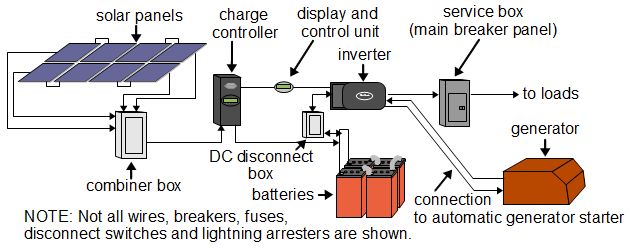
This involves getting power from solar power with an optional generator as backup. See the diagram below. Instead of a connection to the grid, there can be backup power from a generator for when there are too many cloudy days in a row. Optionally the generator can be started and stopped automatically based on the battery voltage. In the diagram below it is a feature of the inverter. If your inverter doesn't have this feature, separate automatic generator starter units are available. Automatically doing this is better than having to run out and start the generator manually when the batteries get too low for two reasons: convenience and you don't want your batteries to go below 50% (without an automatic starter, you'd have to constantly be checking the battery voltage.) As an aside, the diagram below also shows a separate display and control unit, often available depending on the manufacturer of the charge controller and inverter.

- Off-grid system -

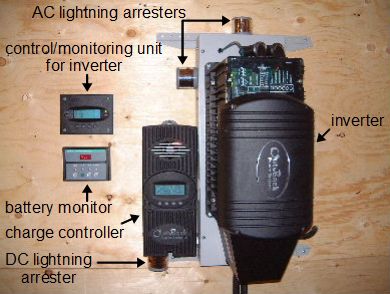
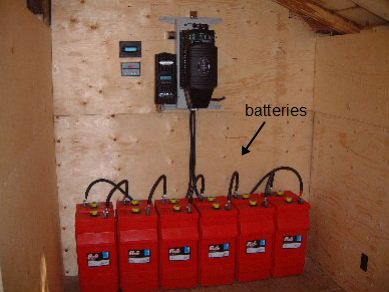
The following photos show a typical system. Most of the wires have been run behind the wall and enter the components from their backs to prevent someone from accidentally hurting themselves.

You'll also notice some things called lightning arresters in the photo on the left. These protect the various components from lightning strikes. If lightning hits a solar panel then the very powerful electricity from the lightning could travel along the wires going between the solar panels and the charge controller and damage the charge controller. For this reason an DC lightning arrester is connected to that wiring and is shown at the bottom of the photo. Similarly there are AC lightning arresters used in case lightning strikes the generator or the wires coming from the generator and in case lightning strikes the household wiring.
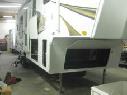
NEW! - For the full step-by-step gory details of an off-grid installation see this off-grid cottege system installed on a motorhome.

Feed-in tarriff (or solar premium)

This involves selling power to the grid exclusively. It is essentially being a mini-power utility. Due to the high cost of solar panels, the amount paid by the power company is usually above cost.
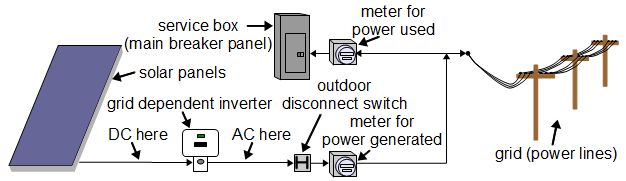
- Feed-in tariff system -

Feed-in tarriff example: Ontario, Canada

In Ontario, Canada the average consumer can pay around $0.20 per kWh for electricity (total bill amount/kWh used.) The Ontario Feed-in Tariff program pays:

The overall program is divided into two: the 10kW or smaller is the microFIT program and larger than 10W is the FIT program, each with different rules. The contract period is for 20 years.

The high cost of solar panels still plays a big part in the decision as to whether or not to go with this approach. The following is a quick back of the envelope calculation to illustrate this. A 2kW PV system costs around $20,000 (rounded up to the nearest $1000):
- 10 panels x 216W per panel at $1,095 each +
- $500 for rack +
- $2,820 for the grid-tie inverter +
- $450 for cables from roof +
- $200 for other parts +
- $2050 for various fees (inspection fee, connection cost, building permit) + - $3000 for installation labour
Assuming an average of 4 hours of sunlight per day, it would generate 4 x 2.16kW per day, which is 8.64kW. 8.64kW per day x 365 days in a year gives 3,153kW per year of generated power. At $0.802 per kW x 3,153kW, that's $2,528 per year of income. Given the initial cost of $20,000 divided by $2,528 per year, it would take 8 years to cover the initial costs and start making a profit for the remaining 12 years of the 20 year contract. The panels typically have a 25 year warranty and the inverter a 10 year warranty. The only part likely to be replaced during the contract is the inverter since there are some electronic components in there that can wear out.

Annual costs will vary. For example, there may be a small account charge with the local distribution company (power company). Also, the system will add to the value of the property, possibly increasing the property taxes. There is also the consideration of getting insurance. The income from this program is taxable income.

However, if grants or subsidies are available then they can reduce the initial cost, giving an earlier payback. Another approach is to have a leasing company purchase the solar panels and other hardware and then lease it to you, causing you to begin making money much sooner, though since you wouldn't own the hardware, you will always have the cost of paying the leasing company.

There were a lot of companies starting up that would "rent your roof". These companies would have the 20 year contract with the Ontario Power Authority and would own the components and just pay you a regular amount for the use of your roof. However, for the microFIT program, < 10kW, in August of 2010 the Ontario Power Authority changed the rules such that only the owner of the property that the system was installed on could have the contract. After that these companies were still able to do this sort of thing but not as part of the microFIT program.

One interesting feature of the Ontario program is the required domestic content. Before January 1, 2011, the installation must have 40% domestic content and on January 1, 2011 that will increase to 60%. The 40% formula basically means all the mounting structure, the hardware and all the wiring must be made in Ontario, and the labour must be from Ontario. The 60% formula will add that the solar panels and the inverter will also have to be made in Ontario.

The purpose of the domestic content requirements is to help grow the green industry in Ontario. Already inverter companies like SMA Solar Technology AG, and solar panel manufacturers such as Canadian Solar, Opsun Panels and Photowatt are working on opening plants in Ontario.

Grid-tied (or grid dependent or net metering)

This involves feeding power to the grid and using power from the grid, paying for only the difference. Notice from the diagram that there are no batteries and so no storage of power. If there is a power failure on the grid then the inverter stops supplying power, even though you still have solar panels.
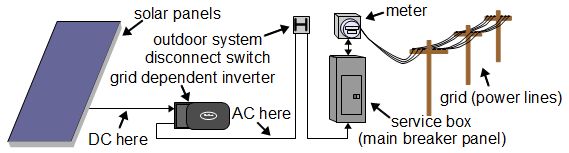
- Grid-tied system -

Usually you do not receive any money for the power you put on the grid. Instead, when your bill arrives, if you used more electricity from the grid than you produced than you pay only for the excess. On the other hand, if you produced more electricity than you used from the grid then you pay nothing for the electricity from the grid and any excess that you produced is kept track of for some period of time. Note that there may still be charges on the electricty bill which will not be reduced.

Example: Ontario, Canada

In Ontario, the program is refered to as net metering. Any excess that you produced is kept track of and is used as a credit against future bills for up to one year. After that time, the excess is forgotten. If before the one year is up, you have a few cloudy months and end up using more from the grid than you produce, then the credits that you accumulated are applied to the excess to reduce or elminate it. So you still may pay nothing. If during that billing period you use up all of your accumulated amount, and then you produce an excess the next month, the one year accumulation period starts over.

In Ontario, there are charges on the bill that are never credited.

As the following photo shows, there are additional safety features needed. If you are feeding power to the grid then you are an electricity generator for the grid. If there is a power failure on the grid due to something happening in your area, say a lightning strike damages something, then the grid workers will come out to fix the problem. Normally you'd think that since the grid is down the workers would be safe to do what they need to do. However, that's not true since your system is putting electricity on the grid.

For that reason, a system that feeds electricity to the grid must have a disconnect switch that is outside (see photo below) so that the grid workers can disconnect your system from the grid. Another typical rule is that they must be able to lock the disconnect switch. That's so that no one else can come along and reconnect your system to the grid while they're still working.

- Net-metering system components -

Note that normally a grid tied inverter would automatically realize that the grid has gone down and stop putting electricty on the grid. But there's always the possibilty of something being wrong with the inverter and it continuing to put electricity on the grid.

Solar backup (or grid interactive)

This involves getting power from the grid with solar power and other renewable energy sources, such as wind and microhydro, as backup. See the diagram below. The inverter is fed power both from the grid (through the main breaker panel) and from batteries. An extra breaker panel, refered to as a subpanel, is installed. The subpanel feeds the loads you need even when the grid goes down (essential loads). While the grid is up, the subpanel is fed through inverter from the grid. When the grid goes down, the subpanel is fed through the inverter from the batteries. This switchover is handled automatically by the inverter. The batteries are kept charged from the solar panels (through the charge controller) and from the grid (through the inverter, as it contains a charger too.)
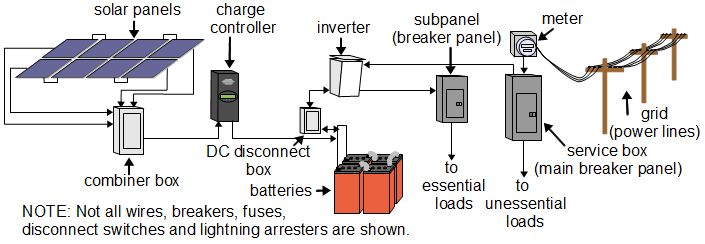
- Solar backup system -