Ontario's MicroFIT/FIT Feed-in Tariff incentive programs
A Feed-in Tariff (FIT) system is one where power is generated and fed onto the electricity grid and the owners of the generating system are paid for that electricity. In this case we are talking about solar power systems.
Between 2009 and 2017, the province of Ontario, Canada, had a Feed-in Tariff program that paid homeowners, schools, companies, and other organizations for solar power that they generated. As of December 31, 2017 the program ended and no new systems are being accepted. But the systems that were installed are still in place, generating power and producing income for those who own the systems for the contracted 20 years.
The program is still a good example of a Feed-in Tariff program and so the details below are where the program stood before it ended.
The program was divided into two: microFIT and FIT. The microFIT was for homeowners, companies, schools, cooperatives and other organizations who own the system and produce 10kW or less. The FIT was also for owners of the systems but produce more than 10kW. The microFIT and FIT each had different rules. The contract period lasts 20 years.
Different amounts are paid depending on the system size and type. Both are up-to-date below. The FIT (>10kW) and microFIT (10kW or smaller) amounts are as of January 1, 2017 and are the amounts that continue to be paid for the life of the contracts.
| Pays | Size | Type | Program |
|---|---|---|---|
| $0.311 | 6kW or smaller | roof mounted | microFIT |
| $0.288 | greater than 6kW and up to 10kW | roof mounted | microFIT |
| $0.210 | 10kW or smaller | non-roof mounted | microFIT |
| $0.223 | 10 to 100kW | roof mounted | FIT |
| $0.207 | greater than 100kW and up to 500kW | roof mounted | FIT |
| $0.192 | greater than 10kW and up to to 500kW | non-root mounted | FIT |
In Ontario, Canada the average consumer can pay around $0.20 per kWh for electricity (total bill amount/kWh used).
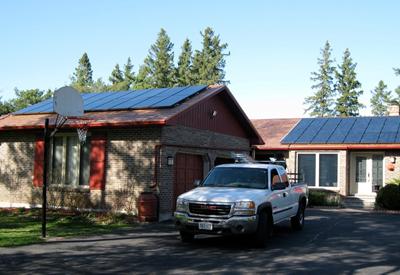
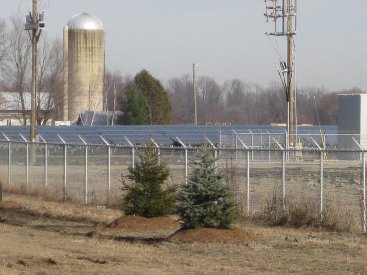
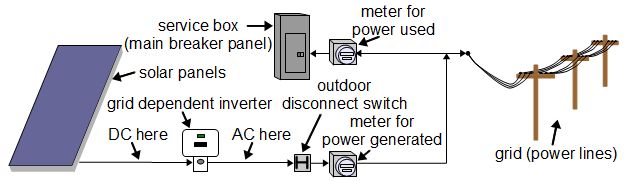
A typical microFIT system diagram
The video below is a good overview of a microFIT system and the program by a person who owns a system.
The costs for a microFIT Verison 2.0 system
The high cost of solar panels still plays a big part in the decision as to whether or not to go with this approach. The following is a quick back of the envelope calculation to illustrate this for a 5kW roof mounted system. As the table shows, a 5kW PV system costs around $22,000 (rounded up to the nearest $1000).
| Cost | Item |
|---|---|
| $6,000 | 20 solar panels x 250W per panel at $300 each |
| $500 | racking/frame |
| $3,400 | 5kw grid-tie inverter |
| $700 | wiring on and from the solar array |
| $200 | other parts/hardware |
| $300 | shipping fees |
| $2050 | various fees (inspection fee, connection cost, building permit, meter) |
| $3000 | certified electrican for final connection |
| $5000 | installation/labour |
| $21,150 | Subtotal |
| $3000 | taxes (HST) but you can get this back so it's not included in the total below |
| $21,150 | Total |
Assuming an average of 3.1 hours of sunlight per day, it would generate 3.1 x 5kW per day, which is 15.5kW. 15.5kW per day x 365 days in a year gives 5,660kW per year of generated power. At $0.311 per kW x 5,660kW, that's $1,760 per year of income. Given the initial cost of $21,150 divided by $1,760 per year, it would take just over 12 years to cover the initial costs and start making a profit for the remaining 8 years of the 20 year contract. The panels typically have a 25 year warranty and the inverter a 10 year warranty. The only part likely to be replaced during the contract is the inverter since there are some electronic components in it that can wear out.
Annual costs will vary. For example, there may be a small account charge with the local distribution company (power company). Also, the system will add to the value of the property, possibly increasing the property taxes. There is also the consideration of getting insurance. The income from this program is taxable income.
However, if grants or subsidies are available then they can reduce the initial cost, giving an earlier payback. Another approach is to have a leasing company purchase the solar panels and other hardware and then lease it to you, causing you to begin making money much sooner, though since you wouldn't own the hardware, you will always have the cost of paying the leasing company.
Domestic content requirements for microFIT
As of July 25, 2014 there are no more domestic content requirements. Solar panels, inverters, and all other materials as well as labor can be sourced from outside Ontario if desired.
The purpose of the domestic content requirements was to help grow the green industry in Ontario. Inverter companies like SMA Solar Technology AG, and solar panel manufacturers such as Canadian Solar and Opsun Panels now have plants in Ontario as a result of this now defunct requirement. In an even older version of this program the domestic content requirement was 60% which meant pretty much everything had to be from Ontario.
News
Government
August 31, 2016 - New prices effective January 1, 2017 have been announced.
January 1, 2015 - All pending price changes have been made regarding the microFIT system (10kW or smaller). The amounts paid have decreased by small amounts.
January 1, 2015 - The Ontario Power Authority (OPA) has been merged with the Independent Electricity System Operator (IESO) to form a new organization called the Independent Electricity System Operator (IESO). Both organizations will continue to do the same things they did before. As a result of the needed docmentation changes to reflect this new name, the new version of the microFIT program is version 3.2.
August 29, 2014 - The Ministry of Energy directed the OPA (Ontario Power Authority) to review the amounts paid for the FIT and microFIT programs (the price schedule.) A new price schedule was arrived at and was put into effect for the FIT program as of September 30, 2014. It will not take effect for the microFIT program until January 1, 2015.
July 25, 2014 - The domestic content requirements were removed from the FIT and microFIT programs. Solar panels, inverters, and all other materials as well as labor can be sourced from outside Ontario if desired.
August 26, 2013 - The FIT/microFIT program released new rules as FIT/microFIT Version 3.0. Major changes were to decrease the amounts paid and a significant reduction in the domestic content required.
July 16, 2012 - The microFIT program is now accepting new applications for systems, and has new finilazed rules. It's now designated as microFIT Version 2.0. The above amounts paid table, costs estimate and domestic content details have been adjusted.
March 22, 2012 - The results of the Two-Year FIT Review have been announced. The main highlights are:
- The payment amounts have been significantly lowered, reflecting the lowering prices for solar panels over the years. The new amounts are in the table at the top of this page. As an example, a roof mounted microFIT (<=10kW) used to pay $0.802 per kWh but will now pay $0.549 per kWh. But as you can see from the above back of the envelope calculation, you can still get a payback of under 10 years for the 20 year contract.
- It's been recommended not to go ahead with the CFIT (Commercial FIT) program. This program has long been under consideration for allowing companies to "rent" people's rooftops or property for installing systems on.
- Much has been recommended for encouraging greater community and Aboriginal participation.
July 7, 2011 - The Ontario provincial government released a Progress Report that included the progress regarding clean energy and infrastructure. Highlights on the electricity side are:
- More than 2,000 megawatts of new electricity supply from sustainable, renewable sources have been brought online - enough to power nearly 900,000 homes,
- 13,000 clean energy jobs have been created.
- Reduced coal usage for 2011 by 90% from 2003 and are on track to eliminate all coal altogether by 2014.
- Went from 10 wind turbines in 2003 to 900 in 2011 and now have the capacity to power more than 350,000 homes.
- Have more than 200 megawatts for solar capacity online, enough to power more than 30,000 homes.
- Signed or offered contracts for more than 21,000 small, medium and large clean energy projects and about $13 million in private sector investment, including investment in manufacturing.
Industry growth
The following is a collection of announcements of plants either planned or in production as a direct result of the introduction of the Feed-in Tariff program.
| June 2, 2011 | Hanwha SolarOne has entered into a supply agreement with Photowatt Ontario, Inc.,(PWO) a wholly owned subsidiary of ATS Automation Tooling Systems, where Photowatt will produce Hanwha SolarOne PV modules to serve the Ontario marketplace. |
| April 18, 2011 | Emerson is partnering with Sanmina-SCI to build Emerson solar power inverters at Sanmina-SCI's Ottawa, Ontario, manufacturing facility. |
| April 14, 2011 | United Solar... announced that it will establish a manufacturing facility in Ontario, Canada, that will be operational by August 2011. The 7,000 square meter facility, located at 6135 Morton Industrial Parkway in LaSalle, Ontario, is under lease to the company for 10 years, and will result in the hiring of up to 80 people. |
| February 1, 2011 | Celestica Inc, a contract electronics maker, is expanding solar-equipment manufacturing to serve renewable energy developers seeking lucrative contracts being offered by the Canadian province of Ontario. |
| December 6, 2010 | SunEdison announced today that its affiliate, MEMC Singapore, is partnering with Flextronics to produce solar photovoltaic panels at Flextronics' facility in Newmarket, Ontario. Located in York Region, production of the solar panels is expected to result in more than 100 new jobs for the province. |
| November 25, 2010 | ATS Photowatt officially opened its Photowatt Ontario Green Wing production facility. |
| November 11, 2010 | JNE Consulting and Chinese-based Daqo Group Co. Ltd. are forming a joint venture that will create up to 300 jobs at a solar panel assembly plant in Hamilton. |
| October 20, 2010 | Italian solar photovoltaic manufacturer, Silfab SpA, announced that it is creating an incorporated Silfab Canada in Mississauga, Ontario. |
| October 20, 2010 | Suntech Power and Calisolar Inc., a privately held, vertically integrated manufacturer of solar silicon, wafers and cells have signed a Letter of Intent to construct a solar silicon manufacturing facility in Ontario Canada. |
| October 4, 2010 | Mecasolar has opened a new manufacturing facility in the Canadian city of Wallaceburg (Ontario), adding to its existing factories in California, Greece and Spain. |
| August 12, 2010 | Canadian Solar will establish a new solar module manufacturing facility in Ontario. The facility, located at 545 Speedvale Avenue, West in Guelph, Ontario, Canada, is expected to be ready to commence production early next year, and will be one of the largest solar panel module manufacturing plants in North America. |
| August 2010 | Samco Solar, formerly just an aut parts manufacturer, opened a plant in Scarborough, Ontario, to produce solar mounting systems resulting in 15 to 18 fulltime positions. |
| May 10, 2010 | With an announcement May 7, the community [Sault Ste. Marie, Ontario] is entering into a new phase in the green sector. Heliene Canada is constructing a solar panel manufacturing facility on Second Line, which will employ up to 36 people. |
| March 9, 2010 | SMA Solar Technology AG is to strengthen its presence in North America with the foundation of a subsidiary in Canada. |
| March 1, 2010 | Schletter GmbH announced today that it will begin office operations of its Canadian subsidiary company, Schletter Canada, Inc., in April. By May, Schletter Canada's manufacturing and distribution facility will be fully operational for order fulfillment, manufacturing, and distribution. |
| December 4, 2009 | Opsun Panels Inc., a subsidiary of Opsun Technologies Inc., has decided to set up a 50 MW solar panel production line in Ontario to meet the Feed In Tariff's Domestic Content requirement. |
