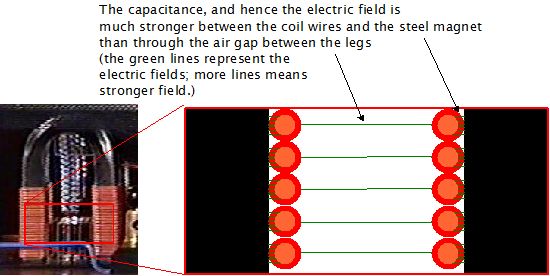
Most people, myself included, had paid attention only to the
capacitance of the testatika magnets as involving the space
between the legs of the magnets. In fact, the majority of the
capacitance comes from the electric field involving the body
of the magnet and only a little from the electric field between
the legs of the magnets.
The following measurements were made with steel magnets to demonstrate
this.
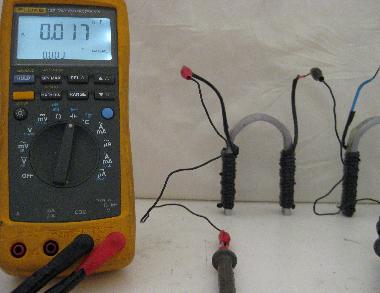
Capacitance measured between two coils on opposite legs of
a horseshoe magnet (17pF).
 |
|
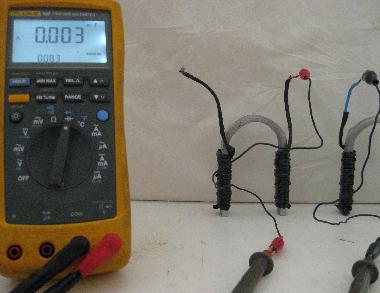
Capacitance measured between two coils spaced apart the same
amount but attached to different magnets (3pF).
 |
|
In the 3kW testatika machine there are what appear to be clear
plastic blocks between the legs. The following shows that if the
blocks are just plexiglass then their contribution to the overall
capacitance is still small. The majority of the eletric field
interaction is still with the magnet material. Note that there
are no such blocks between the legs of the dual disk small machine's
magnets.
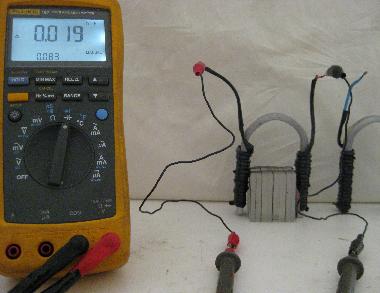
The gap filled with plexiglass, copper and aluminium plates.
Notice that the increase in capacitance is small (19pF instead of 17pF,
a contribution of just 2pF).
 |
|
Note that the above may be incorrect for the 3kW machine if the
blocks are something other than plain plastic and that have a
high permitivity.