Solar issues in a cold climate/winter
Many solar systems have to deal with water freezing in pipes, batteries cracking from ice, panels or collectors being covered in snow, ... Hopefully, the following will help with some of this.
Keeping panels clear of snow, ice and frost
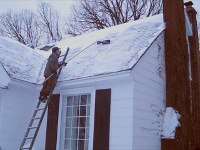
Using a broom, brush or roof rake - Panels mounted close to the ground can usually be cleared with a broom or brush. Panels on a roof can sometimes be cleared using a brush on the end of a long pole, or a telescoping pole, usually called a roof rake (see the photo on the right.)
This doesn't work if you don't have room in front of the the panelled section of your roof to get a good angle with the roof rake or to put a ladder at a safe angle. This is normally the case when houses are close together and/or the house is 2 or more stories high. Mounting a ladder for a 2 story house is also extra dangerous. If you do put up a ladder, tie it off somehow to the roof and make sure there is good footing on the ground for the base of the ladder.
Preheating from the inside out - With some panels snow, ice and frost can be melted simply by circulating warm indoor air (e.g. solar air heaters) or a warm indoor temperature water/glycol mix (e.g. solar hot water heaters) through the panels and warming the panels up from the inside out. This doesn't work with vacuum tube systems, since heat inside a tube doesn't warm up the outside of the tube, or PV panels, since there's no internal heat available.
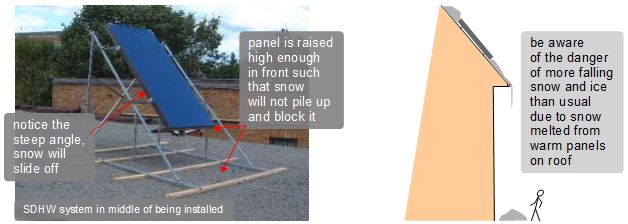
Angle of the panels - If the panels are mounted steeply enough then snow will just fall off eventually. However, the proper angle for a system is usually determined by other factors such as making the panels face the sun directly. The summer sun is high in the sky and so panels are sometimes mounted on a shallow angle and left that way year round. Or they may be mounted flush to a shallow roof.
If it is possible for snow to pile up in front of the panels, make sure to raise the panels high enough so the snow won't block them (see photo below.) Also, snow falling off a warm panel might result in more snow falling off your roof if your roof is normally cool.
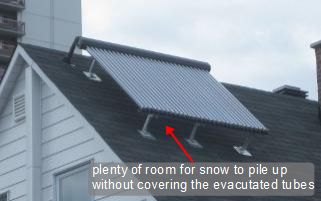
If you have evacuated tubes and snow might accumulate on roofs, make sure the evacuated tubes are raised up off the roof, as shown below. Evacutated tubes are so efficient that even though the heat tube inside may be hot, the exterior of the tube will still be cold. Snow will not melt off. So make sure the tubes are raised higher than snow will pile up, as in the photo on the right.
Note that this is not as much of an issue with flat panels because they are less efficient. Their outer face will warm up when there is sun and eventually melt snow.
Detailed methods for keeping panels clear:


Other ideas for removing snow from solar panels
Toss something up on the end of a rope - Tie a moderately heavy, but blunt object to one end of a rope and throw this up onto the panels. The object can be something such as a large sock filled with something heavy enough to suit the amount of snow it will have to penetrate on the panels. Pull it back down off the roof, taking some snow with it. Throw it back up repeatedly to at least expose a bit of each panel. The sun will then heat the dark panels, melting snow to expose the rest of the panels.
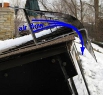
Steep angled absorber mounted on bottom of solar panel - The idea here is to have a solar heater panel of some sort mounted on a steep angle at the bottom of the solar panel. Since it's on a steep angle, snow will just slide off. Since it's in contact with the solar panel, heat from it will conduct to the solar panel and begin snow melting. The diagram below uses just a bare, black absorber plate.
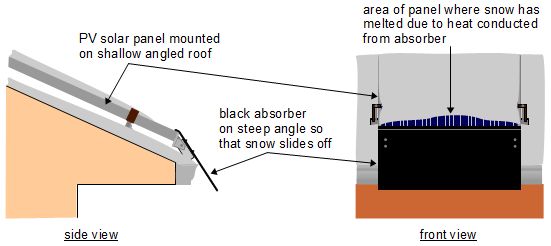
I tried to think of a way of it being a solar air heater with glazing and an open top for hot air to flow up onto the panel but then water would flow down onto the plate, possibly turning to ice at some point or evaporating and fogging up the glazing. Another idea is to have glazing in physical contact with the top surface of the absorber plate to provide some insulation. Experimentation needed.
A remote, mechanical means of clearing snow - One idea is to have some sort of mechanical wiper blades that would sweep across the panels. The wipers can either be motorized or manipulated from the ground via ropes/pulleys or chains/sprockets.
Even more fancy would be to have the panels able to vibrate under the influence of a vibrating motor. As the panel vibrates, the snow would slowly move downward and off the panel.
Blow it off with compressed air - To blow the snow off, have a small compressor indoors with a hose leading to a manifold with multiple outlets at the tops of the panels. The combination of blowing air and the fact that the air is warm air should at least clear enough panel so that the sun can start heating the dark panels and do the rest of the work.
Thanks to Gary, Bob, Scott S. and Scott L. of the
SimplySolar yahoo group for some of these suggestions. Note that
these are just ideas, untested as far as I know. If you are aware of
any of these ideas having been tested, or you try one of them yourself,
please let me know
( ).
).
