Solar air heater manufacturers
| Product | Primary Use | Type | Glazing? | Can combine multiple? |
Manufacturer | CSA Performance Factor* |
|---|---|---|---|---|---|---|
| SolarSheat | residential | backpass | tempered glass |
yes | Your Solar Home Inc. | 0.44 |
| Cansolair | residential | backpass | lexan | no | Cansolair Inc. | N/A |
| Twinsolar | residential | backpass | tempered glass |
yes | Grammer Solar Gmbh | N/A |
| Jumbosolar | commercial/ multi-dwelling |
backpass | tempered glass |
yes | Grammer Solar Gmbh | N/A |
| Luba SolarTM | commercial/ multi-dwelling |
matrix | no glazing | yes | Enerconcept Technologies Inc. | 1.1 |
| MatrixAirTM Delta Roof | commercial/ multi-dwelling |
matrix | no glazing | yes | Matrix Energy Inc. | 0.81 |
| LubiTM | large scale wall | matrix | perforated polycarbonate |
yes | Enerconcept Technologies Inc. | 1.2** |
| MatrixAirTM Backpass | large scale wall | backpass | no glazing | yes | Matrix Energy Inc. | 0.85 |
| MatrixAirTM Transpired | large scale wall | matrix | no glazing | yes | Matrix Energy Inc. | 0.86 |
| SolarWall | large scale wall | matrix | no glazing | yes | Conserval Engineering Inc. | 1.0 |
| Unitair Wall® | large scale wall | backpass | no glazing | yes | Enerconcept Technologies Inc. | 0.69 |
* CSA (Canadian Standards Association) Performance Factor is obtained
from
here.
** The Lubi can use the back wall of the building as the absorber
and so it can be any color. The 1.2 rating above is for a black
absorber, the color used by most solar air heaters. See the Enerconcept
page on the CSA link above for ratings for other colors.
SolarSheat
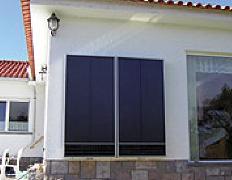
The SolarSheat is made by Your Solar Home Inc. The collector is glazed and takes indoor air from one end in the rear, heats it behind the absorber, and sends it back indoors through another hole at the other end in the rear.
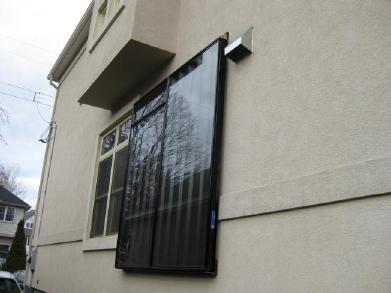
Multiple SolarSheats can be connected together for more heat either side by side or end-to-end. The fan is powered by solar electricity. You can see the photovoltaic panel in the above photo in the top of the panel on the left. The second connected panel doesn't have a fan and so is much cheaper than the first. SolarSheat also has a kit for connecting the inlet and outlet to your regular ductwork. The output from the panels would go to the input of your furnace. If the sun is out then the air coming from the panels and going into the furnace would be hot. The furnace thermostat would realize this and not turn on the burner. But it would still run the furnace fan in order to circulate the freely heated air through the ducts in the house.
Cansolair (often incorrectly called Cansolar)
The Cansolair is made by Cansolair Inc. Similarly to the Solarsheat above, the collector is glazed and takes indoor air from one end in the rear, heats it behind the absorber, and sends it back indoors through another hole at the other end in the rear. Unlike the solarsheat though, the fan is powered by AC, typically by plugging into a wall socket.
The following photos are of an instalation I did for a customer (with Isolara Energy Services).
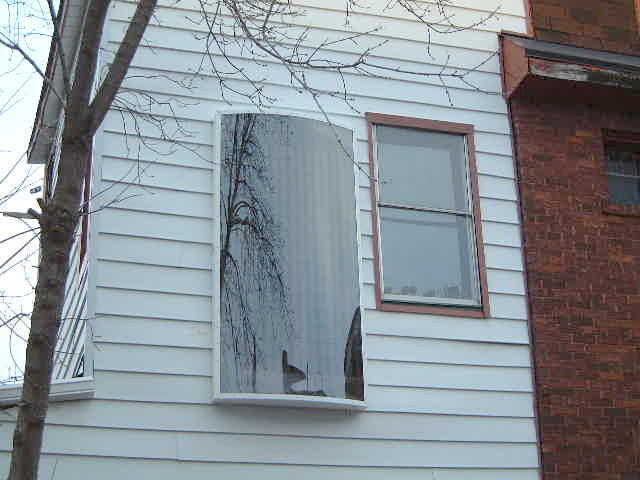

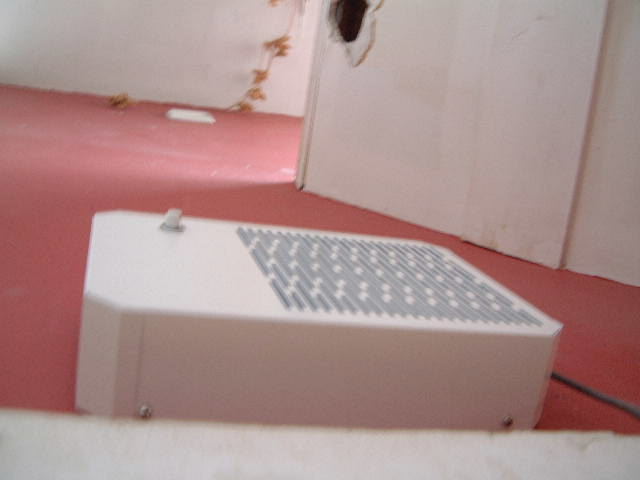
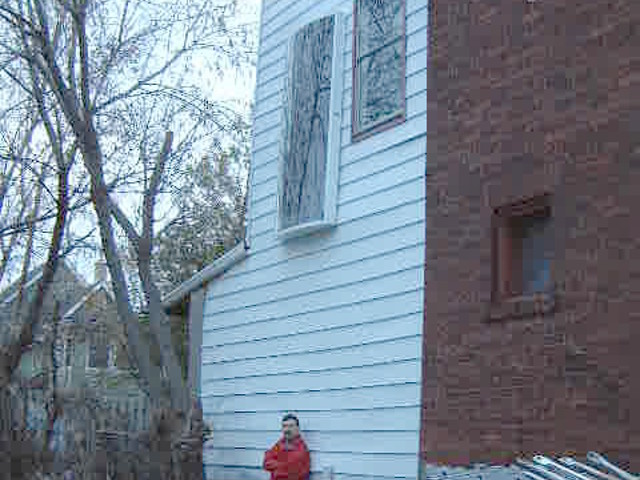
The absorber is actually made of recycled soft drink cans, hence the name "can"solair. Holes are made in the tops and bottoms of the cans and they are then stacked on top of each other. The outsides are painted flat black and the air circulates through the middle. When the air moves from one can to another, it is made to vortex or rotate, causing more of the air to actually come in physical contact with the inner surface of the can/absorber, enhancing its heat exchange ability. See my own experiments for doing solar heating with stacked cans.
Twinsolar and Jumbosolar
These products are made by Grammer Solar Gmbh. The Twinsolar is mainly for small systems such as residential and has a fan powered off of solar electric (photovoltaic) panels. The Jumbosolar is intended for larger systems such as warehouses and office buildings. The Twinsolar use their SLK collector whereas the Jumbosolar uses their GLK collector. All of their products allow combining multiple collectors together. Variations also include whether the air is taken from outdoors or indoors. Both are glazed.
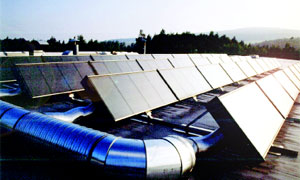
An interesting side note is that Grammer Solar also offers a product which allows you to heat water with this system using a heat exchanger. This solves the problem of what to do with the heat during the summer. Here's report of a customer installation of their system for using solar hot air to heat water.
LubaSolar
The Luba Solar system is from Enerconcept Technologies Inc. It is typically mounted on roof tops but can also be situated on the ground and attached to an inclined surface. It consists of unglazed collectors which can be combined together to form a line of multiple collectors. Outside air is taken in through the perforated absorber, passes behind the absorber through one or more collectors and exits one end, typically into ducts which carry the fresh, heated air into the buildings heating and ventilation system.
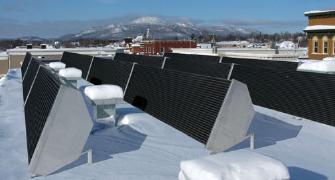
MatrixAir Delta Roof Mounted system
This system is made by Matrix Energy Inc. It's intended for intallation on roofs. It consists of unglazed collectors where the absorber is perforated with many holes and outside air is heated as it's sucked in through the holes.
Lubi
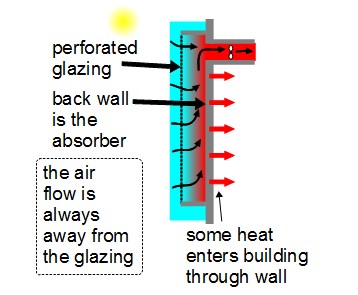
The Lubi system is from Enerconcept Technologies Inc. It's designed for use on walls, typically of commercial buildings. The glazing is perforated and is where the outdoor air enters through. The absorber can be the existing wall of the building or a back sheathing can be used instead. The air enters through the holes in the glazing, goes to the absorber where it is heated, and then on into the building (except when using a heat pump.) Since the air flow is always away from the glazing, heat loss to the outside air through the glazing is eliminated. This gives it a very high performance factor (see table at top) and efficiency.
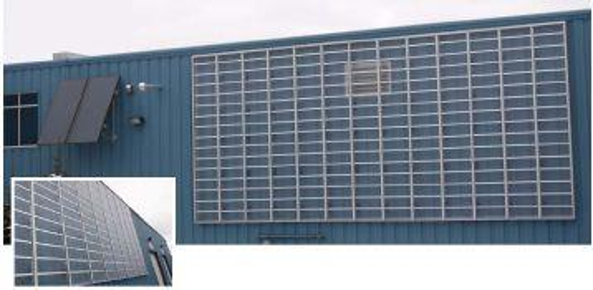
MatrixAir Backpass and Transpired Collectors
These collectors are made by Matrix Energy Inc.
The MatrixAir Backpass Collector has an unglazed absorber but unlike most wall/facade type of collectors, there are no holes in the absorber panels. Instead, as the absorber heats up, air behind it is sucked up and heated as it contacts the back of the absorber. In addition, air on the outside also comes in contact with the absorber and is heated and sucked in at the top to be mixed with the air that was heated from behind.
The MatrixAir Transpired Collector, like most other wall/facade collectors, consists of an unglazed absorber which is perforated by many holes. The absorber heats up and this heat is passed on to the outside air as it is sucked in through the holes. One interesting difference with this collector system is that the air is not sucked upward but is rather sucked downward to a location below the mid-point of the wall and into the building.
SolarWall
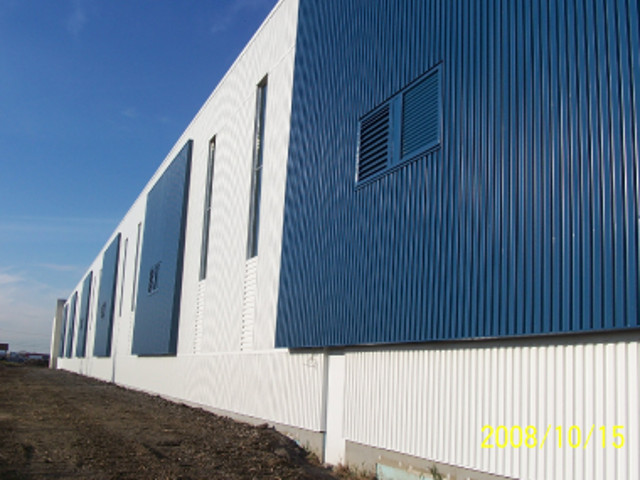
The SolarWall is made by Conserval Engineering Inc. Primarily it is a dark colored wall with many holes in it that preheats outside air before bringing it into the building. There is no glazing. The following videos illustrate how it works.
SolarDuctTM - Conserval's SolarDuct is basically the SolarWall integrated with a ducting system behind it and is suited for putting on flat roofs rather than mounting on walls.
SolarWall PV/TTM and SolarDuct PV/TTM - Conserval also has another product which is the SolarWall or SolarDuct combined with solar electricity generation (photovoltaics or PV.) Solar cells for generating electricity become less efficient as they get hotter. By placing a SolarWall directly behind the PV panels, the heat is sucked away from the panel through the SolarWall and into the building making the panel more efficient than it would otherwise be if it remained hot. The gains are therefore increased efficiency in electricity generation and a hot air supply to the building.
Unitair Wall
The Unitair Wall is from Enerconcept Technologies Inc. It's primary use is in large scale coverage of building walls. It takes outside air at the bottom of the collector, heats it in a chamber behind the unglazed absorber, and sends it inside.