Amp hour meter (battery status monitor)
An amp hour meter tells you state of charge (SOC) of a solar system's battery bank. It doesn't measure it directly but instead it figures out the current going to and from the battery bank and uses that to deduce the SOC. It does this through the use of a shunt.
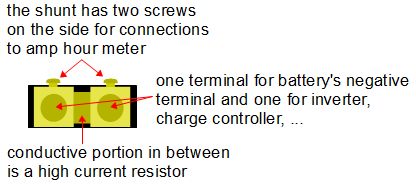
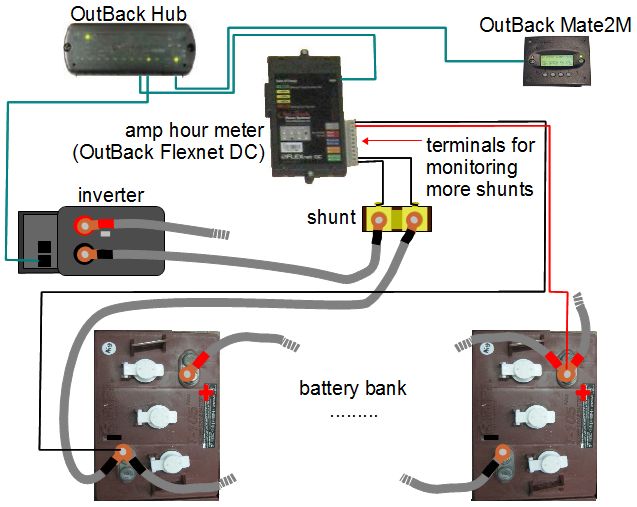
The shunt is a separate component that has two sides for connecting things to it (see the diagram on the right.) In between the two sides is a resistor. As the batteries are charged or discharged, electrical current flows from one side of the shunt to the other side through this resistor.
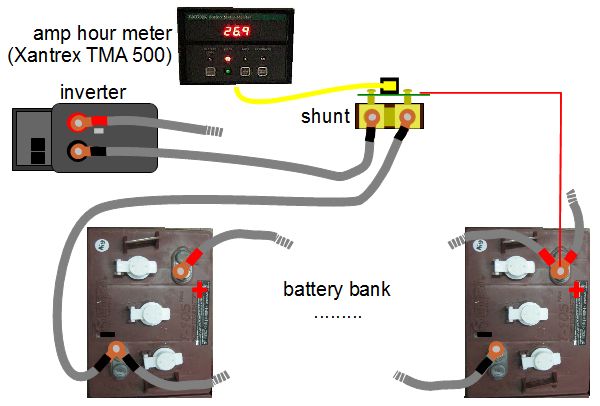
On each side is a large terminal and a small terminal. The large terminal on one side is for connecting to the negative terminal of the battery bank and the large terminal on the other side is for connecting to everything else (inverter, charge controller, ...) The small terminals are what the amp hour meter connects to.
The amp hour meter doesn't measure the electrical current going through it directly, but instead measures the voltage and deduces the current since it's related to the voltage.
Example: OutBack Flexnet DC amp hour meter
The Flexnet DC from OutBack Power Systems has terminals for monitoring more than one shunt at a time. This way you can separately monitor the battery bank's state of charge while also monitoring battery usage from loads connected to an inverter, the charging of batteries from solar panels through a charge controller, charge being taken from DC loads connected directly to the batteries, ... As well as having LEDs, it uses the OutBack Mate for control and monitor through it's screen.
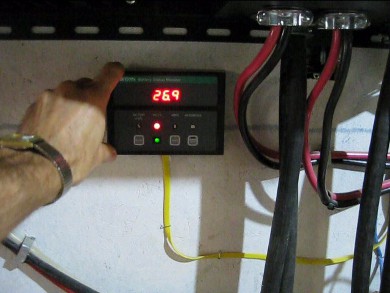
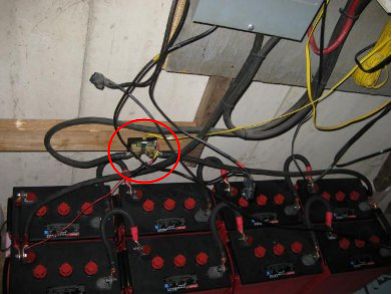
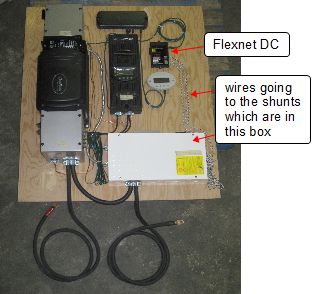
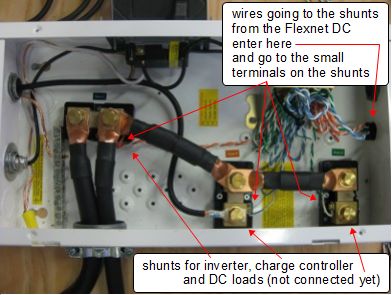
Here are some photos from a board I put together while working for Ottawa Solar Power.
Example: Xantrex TM500 Battery Status Monitor (amp hour meter)
The Xantrex TM500 connects one shunt, which is sufficient for most systems. It comes in two pieces, one is the monitoring and control panel with an integrated displs and the other is a small circuit board which you attach to the two small termnals on the side of the shunt. A long yellow cable then connects the circuit board to the monitoring and control panel. A wire extends from the circuit board to the battery bank's positive terminal. A different version of amp hour meter also has a button for turning on/off a Xantrex inverter.