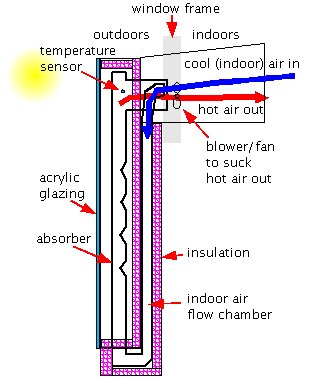
For a few experiments such as solar air heaters, I needed a automatic
turning on and off of a fan. Probably the simplest way to do this is
with a bimetal snap disc thermal sensor.
A bimetal snap disc thermal sensor is basically a switch that closes when
a specific high temperature is reached and opens when a specific lower
temperature is reached. That way, by connecting in a fan in series with
the switch, the fan would turn on when the high temperature is reached
and off then the lower temperature is reached. They are also referred
to as snap disk controllers and snap switches.
Alternatively, there are ones that instead close when the lower
temperature is reached and open when the higher temperature is reached.
The one pictured is KSD020, which is normally closed until a temperature
of 38C/100F is reached at which point it opens. It's rated for
125VAC, 12A.
Make sure you get one where the temperature that turns on the
fan (the switch closes) is higher than the temperature that turns
off the fan (the switch opens.) Most people use ones that turn on
at 110F and off at 90F.
WARNING: Many of the following photos and videos show Romex wire
being used for the length of wire extending into the solar air
heater to the snap disc sensor. These were used in experimental
situations. If you're making a solar air heater or something else
where the wires will be in a heated location then consider using
teflon insulated wire instead.
Why? If the insulation melts it may cause a short circuit and result
in a fire. For example, if it's a sunny day and no air is being
circulated through
the solar air heater because the house is already hot enough then the
temperature where the wire is inside the solar air heater may get
over 200F (93C). This may be over the wire's insulation's rating.
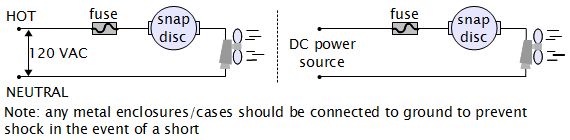
The following are the simplest circuits that can be used, one using
AC and one using DC.
WARNING: The following circuit connects to
household power. Do not do this unless you are
familiar with electronics. If you're using batteries as the power source
instead then it's safer.
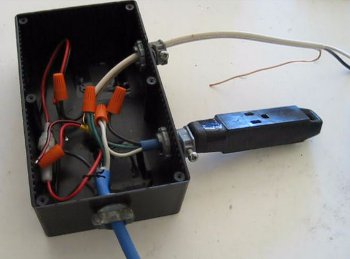
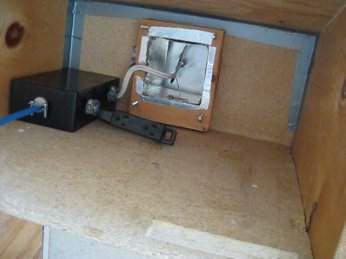
Notice the snap disc sensor on the end of the
white wire, extended into the hot area of the solar air heater.
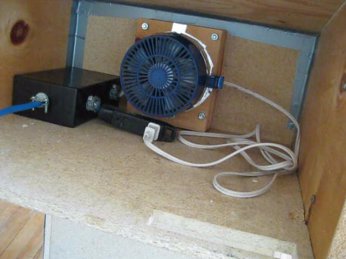
The fan mounted in place and plugged in and everything ready to go.
The following videos give step-by-step details for making the
AC circuit. The first video introduces the snap disc sensor, tests a
prototype circuit and shows how to determine the size of fuse needed for
your fan or blower. It's especially useful for anyone not familiar
with electronics.
Part 1 - Wiring a snap disk controller for a solar air heater
This next video wires up the actual circuit in a safe manner (safety
is imporant here since it's being plugged into the household
wiring), assembles it all in a nice box, puts it in the actual solar
air heater and does a quick test.
Part 2 - Wiring a snap disk controller for a solar air heater
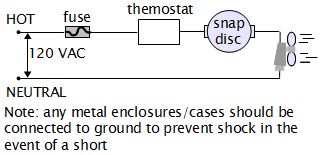
Adding a thermostat for added control based on room temperature
If your room is already hot enough then you don't want your solar air
heater to provide more hot air. This can be controlled by adding a
thermostat to the circuit. The thermostat is basically another switch
that opens when the room is hot enough and closes when the room
needs more heat. The following diagram has the themostat added.
Simplest fan (or other device) control circuit
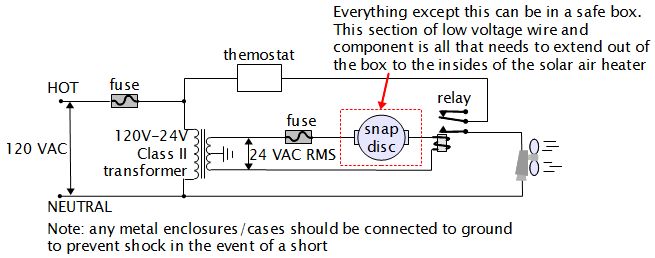
Safer use of household power
The snap disc sensor is located in the solar air heater. Using the above
schematic, the sensor has 120VAC across it. It may be preferable
to have lower voltage wiring in this area and for that the following
schematic can be used. All other circuitry can be housed in a box
that is mounted to the blower/fan enclosure and so all wiring there
can have the higher 120 volts AC while only lower voltage 24 volts AC
wires would extend out to the location of the snap disc sensor.
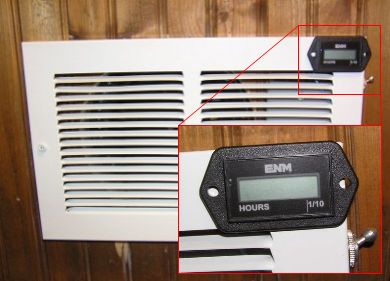
For performance measurement purposes it's often handy to add an hour
meter to the circuit so you can see how long your solar air heater
has run for. An example is shown below on the left of an
hour meter from Grainger, part no. 2PAW9, for $23.77.
In the photo on the right the hour meter is mounted on the
solar air heater input vent for convenience. Click here for details of
this particular solar air heater.
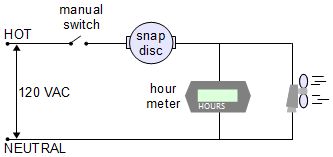
The hour meter would go on the AC side of the circuit anywhere
where these would be no power while the snap disc has turned
off the fan. See the circuit on the right below. (This particular
one also has a manual switch thrown in.)
Examples in solar air heaters
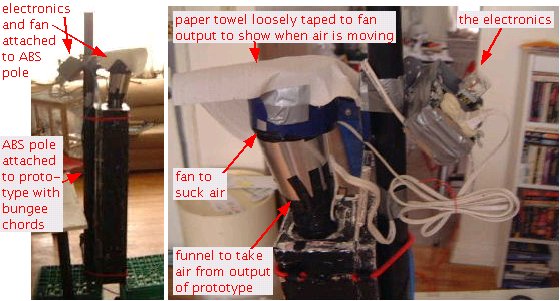
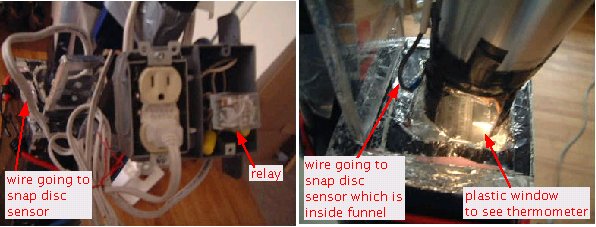
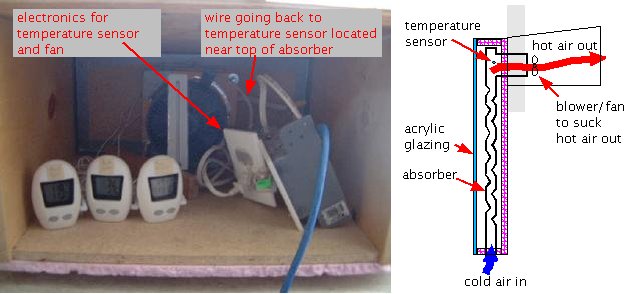
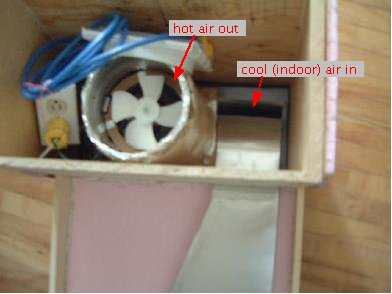
At the time the projects below were done, the only snap disc sensor I
could find in town was a cheap one for around $5.00CDN that worked the
opposite way desired. It opens when
the higher temperature is reached and closes when the lower temperature is reached.
So a relay was added to reverse this, and power had to be supplied to
the relay. The resulting circuit was still simple, but not as simple as
it could have been. WARNING: The following are some photos containing electronics
arrangments that are extremely ugly. :-)